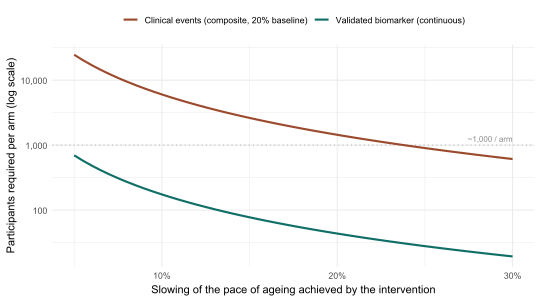
The principles above are not abstractions; they were forged by, and are visible in, the small set of human trials that now define the field. The exemplar is TAME — Targeting Aging with Metformin — conceived explicitly as a regulatory proof of concept rather than a bet on a particular drug (Barzilai et al., 2016). Its design embodies every move of this chapter: metformin, a cheap and exhaustively characterised diabetes drug, tested in older adults against a composite of age-related outcomes — major cardiovascular events, cancer, dementia and death — with the supporting biomarker panel running underneath (Justice et al., 2018). The point was never that metformin is the ideal geroprotector; the meta-analytic evidence in animals is in fact stronger for rapamycin, which mirrors dietary restriction in a way metformin does not (Ivimey-Cook et al., 2025). The point was to establish that a trial against ageing can be designed, run and read — to cut the regulatory path that successors would walk.
Its complement is PEARL, a decentralised trial of low-dose rapamycin that reported acceptable safety and several healthspan signals over a year in a community of self-selected participants, demonstrating both the promise and the limits of the remote, participant-driven model (Moel et al., 2025). Beyond these, the wider landscape is consistent in a way this chapter has prepared us to expect: the first-in-human senolytic studies measured feasibility, tolerability and target engagement — that the drugs reach their tissues and lower senescent-cell burden — rather than disease outcomes (Section 7.3) (Hickson et al., 2019; Justice et al., 2019); the CALERIE analysis read biological age with clocks rather than counting deaths (Waziry et al., 2023); and the reprogramming therapies of Chapter 8 approach their first human tests with the dosing-and-endpoint problem of Section 8.2 still squarely before them. Table 10.1 sets the principal trials side by side.
The common thread is unmistakable. These are, almost to a trial, studies of whether the intervention does what its mechanism says — reaches the target, moves the marker, proves tolerable — and not yet studies of whether it lengthens a healthy life. That is the appropriate state of an early translational field, and nothing to apologise for. But it places an unusual burden on the reader of longevity science, who must constantly distinguish a moved biomarker from a changed destiny, and a regulable composite from a proven benefit.
Alvarez-Kuglen, M., Ninomiya, K., Qin, H., Rodriguez, D., Fiengo, L., Farhy, C., others, Sharpee, T. O., & Terskikh, A. V. (2024).
ImAge quantitates aging and rejuvenation.
Nature Aging,
4(9), 1308–1327.
https://doi.org/10.1038/s43587-024-00685-1
Barzilai, N., Crandall, J. P., Kritchevsky, S. B., & Espeland, M. A. (2016). Metformin as a tool to target aging.
Cell Metabolism,
23(6), 1060–1065.
https://doi.org/10.1016/j.cmet.2016.05.011
Belsky, D. W., Caspi, A., Corcoran, D. L., Sugden, K., Poulton, R., Arseneault, L., Baccarelli, A., Chamarti, K., Gao, X., Hannon, E., Harrington, H. L., Houts, R., Kothari, M., Kwon, D., Mill, J., Schwartz, J., Vokonas, P., Wang, C., Williams, B. S., & Moffitt, T. E. (2022).
DunedinPACE, a
DNA methylation biomarker of the pace of aging.
eLife,
11, e73420.
https://doi.org/10.7554/eLife.73420
Ferrucci, L., Wilson, D. M., Donega, S., & Montano, M. (2023). Enabling translational geroscience by broadening the scope of geriatric care.
Aging Cell,
23(1), e14034.
https://doi.org/10.1111/acel.14034
Gems, D., Okholm, S., & Lemoine, M. (2024). Inflated expectations: The strange craze for translational research on aging.
EMBO Reports,
25(9), 3748–3752.
https://doi.org/10.1038/s44319-024-00226-2
Hannum, G., Guinney, J., Zhao, L., Zhang, L., Hughes, G., Sadda, S., Klotzle, B., Bibikova, M., Fan, J.-B., Gao, Y., Deconde, R., Chen, M., Rajapakse, I., Friend, S., Ideker, T., & Zhang, K. (2013). Genome-wide methylation profiles reveal quantitative views of human aging rates.
Molecular Cell,
49(2), 359–367.
https://doi.org/10.1016/j.molcel.2012.10.016
Hernán, M. A., & Robins, J. M. (2016). Using big data to emulate a target trial when a randomized trial is not available.
American Journal of Epidemiology,
183(8), 758–764.
https://doi.org/10.1093/aje/kwv254
Herzog, C. M. S., Poganik, J. R., Boekstein, N., Fortney, K., Peyer, J. G., Mellon, J., Starr, R., Barzilai, N., & Moqri, M. (2025). Recommendations for biomarker data collection in clinical trials by longevity biotechnology companies.
Npj Aging,
12(1), 16.
https://doi.org/10.1038/s41514-025-00313-1
Hickson, L. J., Langhi Prata, L. G. P., Bobart, S. A., Evans, T. K., Giorgadze, N., Hashmi, S. K., Herrmann, S. M., Jensen, M. D., others, Tchkonia, T., & Kirkland, J. L. (2019). Senolytics decrease senescent cells in humans: Preliminary report from a clinical trial of dasatinib plus quercetin in individuals with diabetic kidney disease.
EBioMedicine,
47, 446–456.
https://doi.org/10.1016/j.ebiom.2019.08.069
Horvath, S. (2013).
DNA methylation age of human tissues and cell types.
Genome Biology,
14(10), R115.
https://doi.org/10.1186/gb-2013-14-10-r115
Ivimey-Cook, E. R., Sultanova, Z., et al. (2025). Rapamycin, not metformin, mirrors dietary restriction-driven lifespan extension in vertebrates: A meta-analysis.
Aging Cell,
24, e70131.
https://doi.org/10.1111/acel.70131
Justice, J. N., Ferrucci, L., Newman, A. B., Aroda, V. R., Bahnson, J. L., Divers, J., Espeland, M. A., Marcovina, S., Pollak, M. N., Kritchevsky, S. B., Barzilai, N., & Kuchel, G. A. (2018). A framework for selection of blood-based biomarkers for geroscience-guided clinical trials: Report from the
TAME biomarkers workgroup.
GeroScience,
40(5-6), 419–436.
https://doi.org/10.1007/s11357-018-0042-y
Justice, J. N., Nambiar, A. M., Tchkonia, T., LeBrasseur, N. K., Pascual, R., Hashmi, S. K., Prata, L., Masternak, M. M., Kritchevsky, S. B., Musi, N., & Kirkland, J. L. (2019). Senolytics in idiopathic pulmonary fibrosis: Results from a first-in-human, open-label, pilot study.
EBioMedicine,
40, 554–563.
https://doi.org/10.1016/j.ebiom.2018.12.052
Kennedy, B. K., Berger, S. L., Brunet, A., Campisi, J., Cuervo, A. M., Epel, E. S., & Sierra, F. (2014). Geroscience: Linking aging to chronic disease.
Cell,
159(4), 709–713.
https://doi.org/10.1016/j.cell.2014.10.039
Levine, M. E., Lu, A. T., Quach, A., Chen, B. H., Assimes, T. L., Bandinelli, S., Hou, L., Baccarelli, A. A., Stewart, J. D., Li, Y., Whitsel, E. A., Wilson, J. G., Reiner, A. P., Aviv, A., Lohman, K., Liu, Y., Ferrucci, L., & Horvath, S. (2018). An epigenetic biomarker of aging for lifespan and healthspan.
Aging,
10(4), 573–591.
https://doi.org/10.18632/aging.101414
Lu, A. T., Fei, Z., Haghani, A., Robeck, T. R., Zoller, J. A., Li, C. Z., Lowe, R., Yan, Q., Zhang, J., Vu, H., et al. (2023). Universal
DNA methylation age across mammalian tissues.
Nature Aging,
3(9), 1144–1166.
https://doi.org/10.1038/s43587-023-00462-6
Lu, A. T., Quach, A., Wilson, J. G., Reiner, A. P., Aviv, A., Raj, K., Hou, L., Baccarelli, A. A., Li, Y., Stewart, J. D., Whitsel, E. A., Assimes, T. L., Ferrucci, L., & Horvath, S. (2019).
DNA methylation
GrimAge strongly predicts lifespan and healthspan.
Aging,
11(2), 303–327.
https://doi.org/10.18632/aging.101684
MetricGate. (2025).
Effect size to sample size calculator. Online documentation and calculator.
https://www.metricgate.com/effect-size-to-sample-size
Meyer, D. H., & Schumacher, B. (2024). Aging clocks based on accumulating stochastic variation.
Nature Aging,
4(6), 871–885.
https://doi.org/10.1038/s43587-024-00619-x
Moel, M., Harinath, G., Lee, V., Nyquist, A., Morgan, S. L., Isman, A., & Zalzala, S. (2025). Influence of rapamycin on safety and healthspan metrics after one year:
PEARL trial results.
Aging,
17.
https://doi.org/10.18632/aging.206235
Moqri, M., Herzog, C., Poganik, J. R., Justice, J., Belsky, D. W., Higgins-Chen, A., Ferrucci, L., Kennedy, B. K., Sebastiano, V., Gladyshev, V. N., et al. (2023). Biomarkers of aging for the identification and evaluation of longevity interventions.
Cell,
186(18), 3758–3775.
https://doi.org/10.1016/j.cell.2023.08.003
Moqri, M., Herzog, C., Poganik, J. R., Ying, K., Justice, J. N., Belsky, D. W., Higgins-Chen, A. T., Chen, B. H., Cohen, A. A., Fuellen, G., Hägg, S., Marioni, R. E., Widschwendter, M., Fortney, K., Fedichev, P. O., Zhavoronkov, A., Barzilai, N., Lasky-Su, J., Kiel, D. P., … Ferrucci, L. (2024). Validation of biomarkers of aging.
Nature Medicine,
30(2), 360–372.
https://doi.org/10.1038/s41591-023-02784-9
Rothwell, P. M. (2005). External validity of randomised controlled trials:
‘To whom do the results of this trial apply?’ The Lancet,
365, 82–93.
https://doi.org/10.1016/S0140-6736(05)17869-1
Tyshkovskiy, A., Kholdina, D., Davitadze, M., Molière, A., Moldakozhayev, A., Tongu, Y., Kasahara, T., Glubokov, D., Eames, A., Kats, L. M., Vladimirova, A., Ying, K., Liu, H., Zhang, B., Khasanova, U., Moqri, M., Van Raamsdonk, J. M., Harrison, D. E., Strong, R., … Gladyshev, V. N. (2026). Universal transcriptomic hallmarks of mammalian ageing and mortality.
Nature.
https://doi.org/10.1038/s41586-026-10542-3
Waziry, R., Ryan, C. P., Corcoran, D. L., Huffman, K. M., Kobor, M. S., Kothari, M., Graf, G. H., Kraus, V. B., Kraus, W. E., Lin, D. T. S., Pieper, C. F., Ramaker, M. E., Bhapkar, M., Das, S. K., Ferrucci, L., Hastings, W. J., Kebbe, M., Parker, D. C., Racette, S. B., … Belsky, D. W. (2023). Effect of long-term caloric restriction on
DNA methylation measures of biological aging in healthy adults from the
CALERIE trial.
Nature Aging,
3(3), 248–257.
https://doi.org/10.1038/s43587-022-00357-y