Why a book about ageing now — and why one that treats it as a single, partly modifiable process rather than an inventory of separate diseases.
The argument of this work begins with a reversal of figure and ground. For most of the history of medicine, ageing was the backdrop against which disease was diagnosed and treated — the slowly darkening stage on which the real dramas of cancer, infarction and dementia were played out, but never itself a thing that medicine set out to treat. The wager organising the chapters that follow is that this arrangement has it backwards: that ageing is not the stage but the principal actor, the common upstream process whose unfolding makes each of those diseases progressively more likely, and that it may itself be open to intervention. To take that wager seriously is to ask three questions, and to keep them from collapsing into one another: whether ageing can be slowed or reversed, whether it should be, and for whom. Sorting those questions, and arming the reader to tell a demonstrated answer from a marketed one, is the work of the pages that follow.
Ageing as the master risk factor
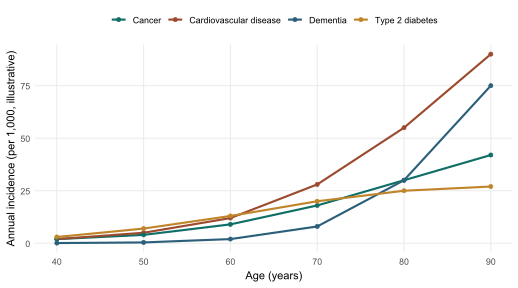
Begin with the fact from which the whole enterprise grows. For the major chronic diseases of affluent societies — cardiovascular disease, most cancers, type 2 diabetes, the dementias — the strongest single predictor is not any particular behaviour or exposure but chronological age itself (Niccoli & Partridge, 2012). Smoking, diet and inheritance matter, sometimes greatly; but their effects are modulations upon a far larger underlying trend, which is that the probability of falling ill with almost any of these conditions rises steeply with the years lived. And it rises not gently but with acceleration: across most of adult life each additional decade tends to multiply the hazard rather than add to it, so that the risk curves bend sharply upward in the final decades (Figure 1).
Figure 1: Why age is treated as the master risk factor: the incidence of several major chronic diseases rises steeply, and with acceleration, across later life, so that age dominates the shared risk of otherwise unrelated conditions. The curves are illustrative and schematic — transcribed to capture the qualitative pattern documented in the geroscience literature rather than any single dataset (Kennedy et al., 2014; Niccoli & Partridge, 2012) — and are not intended as exact incidence estimates.
For most of the twentieth century this observation was treated as an actuarial backdrop — a fact about when diseases arrive, not a target for medicine. What changed in the last two decades is the inference drawn from it. If age is the dominant shared risk factor across an entire family of otherwise unrelated diseases, then the biological processes of ageing are their common soil, and an intervention that slowed those processes might postpone the whole family together rather than picking off its members one by one. This is the founding premise of geroscience: that ageing is the upstream driver of late-life disease, and therefore the most efficient point of leverage against it (Kennedy et al., 2014). The contrast with the disease-by-disease medicine of the past century is stark. That medicine has been heroically successful at defeating individual causes of death, yet its very success exposes its limit: a patient cured of one age-related disease is, by virtue of being old, left exposed to the next. Treating each condition as it surfaces is a contest against a hydra. Treating the ageing that grows the heads is the move geroscience proposes, and the hallmarks framework examined in Part I is the attempt to specify what, mechanistically, that common soil consists of (López-Otín et al., 2023; Partridge et al., 2020).
NoteKey concept — geroscience
Geroscience is the hypothesis that the biological processes of ageing are the principal shared cause of the major chronic diseases, and that targeting those processes — rather than each disease in isolation — is the more powerful therapeutic strategy. Its promise is a compression of several diseases at once; its burden of proof is correspondingly heavier, because a claim about a common upstream cause must be demonstrated against the whole family of downstream conditions, in humans, over long horizons.
The reversibility paradigm
A risk factor one can only watch is of limited therapeutic interest. What turned ageing from an object of description into an object of intervention was evidence that the underlying process might be not merely slowed but, in part, undone — that the arrow of biological time has, in principle, a return path. The evidence came from an unexpected quarter. In 2006 Shinya Yamanaka showed that introducing four genes into an adult cell could erase its specialised identity and return it to an embryonic, pluripotent state (Takahashi & Yamanaka, 2006). The four Yamanaka factors were, in effect, a factory reset for the cell — and a reset is a reversal. The discovery transformed regenerative biology; but it also planted a more radical thought. If a cell’s developmental clock can be wound fully back, might it be wound back only a little — far enough to recover youthful function, but not so far as to wipe out the cell’s identity altogether?
That thought became partial reprogramming. In 2016 Izpisúa Belmonte and colleagues at the Salk Institute expressed the factors cyclically and transiently in mice, extending the life of animals with a premature-ageing syndrome and improving tissue regeneration in normal old ones, without returning their cells all the way to the embryonic state (Ocampo et al., 2016). In 2020 a second landmark sharpened the claim into something measurable: delivering three of the factors to the retinal nerve cells of mice restored a youthful pattern of DNA methylation, promoted nerve regeneration and reversed vision loss in models of glaucoma and old age — a result that appeared on the cover of Nature under the heading “Turning Back Time” (Y. Lu et al., 2020). The crucial word in that study is restored. It implied that the youthful pattern had not been destroyed by ageing, merely obscured, and that a record of it survived in the old cell to be recovered.
That implication is the conceptual centre of the present inquiry. A growing body of work now frames ageing not as the accumulation of irreparable damage but, at least in significant part, as a progressive loss of epigenetic information — a drift in the marks that tell each cell which of its genes to read and therefore which kind of cell to be — such that the organism slowly forgets the instructions for its own youthful state (J. Y. Lu et al., 2025; Yang et al., 2023). On this reading, captured in the phrase one of the field’s pioneers now uses, ageing is at bottom “a loss of identity at the cellular level”, and reversal means helping the cell remember (Izpisua, 2026). Whether that reading is correct, how far it extends, and what it can and cannot yet do in a human being are questions for the chapters ahead. But it is the organising idea against which everything else in these pages is measured: the reframing of ageing from inexorable decline into a process with, in principle, an undo function.
A field in motion
Ideas of this potency do not stay in the laboratory. The reprogramming research that began in academic institutions — the Salk Institute, and university laboratories in Boston, Cambridge and elsewhere (Browder et al., 2022; Ocampo et al., 2016) — has in the space of a few years drawn extraordinary sums of private capital and migrated, in large part, into a cohort of well-funded ventures. Altos Labs launched in 2022 with roughly three billion dollars in backing, a record for a biotechnology start-up, with cellular reprogramming as its explicit focus (Ledford, 2026); Retro Biosciences was seeded with a hundred and eighty million from a single technology investor (Regalado, 2023); and other firms, among them New Limit, Life Biosciences and Shift Bioscience, have entered the same terrain. The vocabulary of the field has shifted accordingly, from the cautious conditional of the laboratory towards the confident register of the funding announcement.
The institutional threshold was crossed as these pages were being written. Life Biosciences — a company co-founded by one of the most visible figures in the field — secured regulatory clearance for what is described as the first targeted attempt at age reversal in human volunteers: a small trial that delivers three reprogramming genes (the OSK factors) to the eye of patients with glaucoma, under a genetic switch designed to keep the genes active only while a low dose of an antibiotic is taken (Regalado, 2026). The intervention is the direct descendant of the 2020 vision experiment, carried from mouse to clinic. Its modesty is worth marking against the scale of the rhetoric that surrounds it: a dozen patients, one eye each, a single contained organ chosen precisely because it can be treated in isolation and watched closely. The same reprogramming that rejuvenates a tissue can, pushed too far, return cells so close to the embryonic state that they lose their function or turn cancerous, and that hazard is the reason the first human attempt is so circumscribed.
These pages report that moment; they do not yet judge it. The distance between a regulator-cleared first-in-human trial in one eye and the “reversal of ageing” proclaimed from conference stages is exactly the territory the later parts are written to map. Here it is enough to register that the science is real, the capital is vast, the first human test has begun, and the gap between what has been shown and what has been promised has rarely been wider.
Three tensions
Three fault lines run through the whole of the subject. Naming them at the outset lets the reader carry them, as instruments, into every part that follows.
The first is healthspan against lifespan — the years lived in good health against the total years lived. The responsible ambition of the field is not to extend dying but to compress it: to lengthen the healthy middle of life and shorten the frail end, so that people live well for longer rather than merely surviving longer. Whether a given intervention does the first or only the second is not settled by how much life it adds but by how it adds it, and the economic case for the whole enterprise turns on the difference (Fries, 1980; Scott et al., 2021).
The second is promise against evidence — the distance between a striking result in a short-lived animal and a benefit demonstrated in a human life. This gap is the field’s structural temptation, because the incentives of investment, publication and publicity all reward optimism about how close a therapy is, and the history of ageing research is in part a catalogue of mechanistically beautiful ideas that did not survive contact with a human trial (Demaria, 2025; Gems & Magalhães, 2024).
The third is the individual against society. An intervention that is rational for a person to want may be destabilising or unjust at the scale of a population: a therapy that postpones decline will, by default, reach those already best placed to obtain it, and a society in which healthy longevity can be bought is a society in which inequality may be inscribed into the length of life itself (Daniels, 2008). The Epilogue returns to settle accounts with all three tensions; the chapters between are what make a reckoning possible.
How the book is organised
The three questions of the opening — can it be done, should it be done, and for whom — give the book its architecture, and explain its proportions. The first question is a matter of biology and medicine, and it is the larger task: roughly seventy per cent of the text is devoted to it, across four parts. Part I establishes what ageing is, as a phenomenon and as a structured set of mechanisms. Part II examines the deeper machinery — the epigenetic clocks, the erosion of telomeres and the accumulation of senescent cells, the metabolism that ties ageing to nutrition — and the information-theoretic reading that unifies them. Part III turns to the therapies themselves, from dietary restriction and its mimetics through senolytics to reprogramming and regenerative medicine. Part IV asks the harder, more honest question of translation: what the biomarkers and trials can actually show, and how to read the evidence against the hype.
Only once the science has been laid out do the closing chapters take up the second and third questions. Part V addresses them in turn — the demography and economics of an ageing world, the justice of who gains access to longer health, the ethics of intervening in the human lifespan, and the wider philosophical debate about the convergence of nano-, bio-, info- and cognitive technologies applied to the body. The order is deliberate and the boundary is load-bearing: what is possible must be established before what is permissible or fair can be sensibly argued, and a great deal of confusion in public debate comes from arguing the value questions on the basis of a science that has been misreported.
Readers need not proceed linearly. A biologist may begin at Part I and read through; a clinician may concentrate on Parts III and IV; a reader from economics, demography or public policy will find the core of their concern in Part IV and in the demographic and economic chapters of Part V, though Chapters 1, 8 and 11 supply the scientific grounding those chapters assume; a philosopher or ethicist may go directly to Part V, but is asked to read the first chapter, the chapter on reprogramming and the chapter on hype and evidence first, so that the normative argument rests on an accurate picture of the science rather than on its caricature.
A note on method and evidence
This is a note on how the chapters reason; the question of how the book itself was made — its sources, and the assistance of a language model in its drafting — was addressed in the Preface. The two are distinct, and kept so.
Ageing science is unusually prone to the over-reading of preliminary results, and the chapters that follow apply a consistent hierarchy of evidence to guard against it. A plausible mechanism shown in cultured cells is the weakest form of support and the most easily over-interpreted; a result in a short-lived model organism is stronger but still provisional; human observational data are more relevant but vulnerable to confounding; and only an adequately powered, pre-registered randomised trial in humans, replicated, settles a clinical claim. Effect sizes and confidence intervals are reported where they exist, and the absence of human evidence is marked as absence rather than rounded up to encouragement.
One rule sits above the rest, and the reader is asked to carry it through every chapter as the single most useful instrument of interpretation: a result demonstrated in a mouse, a worm or a dish is a hypothesis about a human being, not a fact about one. The overwhelming majority of the spectacular rejuvenation results in this field are findings in short-lived laboratory animals, and the species barrier between them and us is not a formality to be cleared on the way to the clinic but the central unsolved problem of the entire enterprise (Gems & Magalhães, 2024; Niccoli & Partridge, 2012). Much of the gap between the promise and the evidence, traced throughout these pages, is in the end a gap created by treating that hypothesis as though it were already a fact.
CautionCaveat — the animal-to-human inference
Whenever the text reports that an intervention slowed, halted or reversed some feature of ageing, the reader should ask, before anything else, in what? The answer is, far more often than the headlines suggest, a mouse. Extrapolating from a rejuvenated mouse to a rejuvenated person is the inference on which the commercial and rhetorical excesses of the field almost always rest, and it is the one the chapters that follow most consistently refuse to make on the evidence’s behalf.
The argument proper begins with the question the science had to answer before any of the rest could be posed — the question that looks simplest and is not. Before ageing can be measured, slowed or reversed, it has to be defined precisely enough to study. Part I turns to it: what, exactly, is ageing?
Browder, K. C., Reddy, P., Yamamoto, M., Haghani, A., Guillen, I. G., Sahu, S., & Izpisua Belmonte, J. C. (2022). In vivo partial reprogramming alters age-associated molecular changes during physiological aging in mice. Nature Aging, 2(3), 243–253. https://doi.org/10.1038/s43587-022-00183-2
Gems, D., & Magalhães, J. P. de. (2024). Inflated expectations: The strange craze for translational research on aging. EMBO Reports, 25(9), 3748–3752. https://doi.org/10.1038/s44319-024-00226-2
Kennedy, B. K., Berger, S. L., Brunet, A., Campisi, J., Cuervo, A. M., Epel, E. S., & Sierra, F. (2014). Geroscience: Linking aging to chronic disease. Cell, 159(4), 709–713. https://doi.org/10.1016/j.cell.2014.10.039
López-Otín, C., Blasco, M. A., Partridge, L., Serrano, M., & Kroemer, G. (2023). Hallmarks of aging: An expanding universe. Cell, 186(2), 243–278. https://doi.org/10.1016/j.cell.2022.11.001
Lu, J. Y., Tu, W. B., Li, R., Weng, M., Sanketi, B. D., Yuan, B., Reddy, P., Rodriguez Esteban, C., & Izpisua Belmonte, J. C. (2025). Prevalent mesenchymal drift in aging and disease is reversed by partial reprogramming. Cell, 188(21), 5895–5911.e17. https://doi.org/10.1016/j.cell.2025.07.031
Lu, Y., Brommer, B., Tian, X., Krishnan, A., Meer, M., Wang, C., Vera, D. L., Zeng, Q., Yu, D., Bonkowski, M. S., et al. (2020). Reprogramming to recover youthful epigenetic information and restore vision. Nature, 588(7836), 124–129. https://doi.org/10.1038/s41586-020-2975-4
Ocampo, A., Reddy, P., Martinez-Redondo, P., Platero-Luengo, A., Hatanaka, F., Hishida, T., & Izpisua Belmonte, J. C. (2016). In vivo amelioration of age-associated hallmarks by partial reprogramming. Cell, 167(7), 1719–1733.e12. https://doi.org/10.1016/j.cell.2016.11.052
Partridge, L., Fuentealba, M., & Kennedy, B. K. (2020). The quest to slow ageing through drug discovery. Nature Reviews Drug Discovery, 19(8), 513–532. https://doi.org/10.1038/s41573-020-0067-7
Takahashi, K., & Yamanaka, S. (2006). Induction of pluripotent stem cells from mouse embryonic and adult fibroblast cultures by defined factors. Cell, 126(4), 663–676. https://doi.org/10.1016/j.cell.2006.07.024
Yang, J.-H., Hayano, M., Griffin, P. T., Amorim, J. A., Bonkowski, M. S., Apostolides, J. K., & Sinclair, D. A. (2023). Loss of epigenetic information as a cause of mammalian aging. Cell, 186(2), 305–326.e27. https://doi.org/10.1016/j.cell.2022.12.027