15  Finitude Renegotiated: Ageing, Enhancement and the Human Condition

For millennia, finitude was the fixed frame of a human life — the thing philosophy and religion existed partly to make bearable. The closing chapter asks what changes, in our thinking about meaning, value and the limits of the human, once the frame itself begins to move.

The previous chapter took the ethical questions on their own terms: whether to slow ageing at all, under what conditions of consent and risk, and how the burdens and benefits of a changed lifespan ought to be shared. Those were questions of conduct — what may be done, and to whom. The question that now remains is of a different order. It is not whether the intervention is permissible but what it does to the picture of a human life that the intervention presupposes. Every consolation the species has devised, every account of why a life is worth living and a death worth meeting, was composed on the assumption that the term was fixed. The biology surveyed in Parts I to IV does not yet move that term by much, and may never move it far. But it has done something to the assumption: it has converted finitude from a necessity into a contingency, from the wall against which a life is lived into a variable that medicine might, in principle, adjust. The order of the argument runs from the inheritance to its unsettling and out to the open question. The first section reconstructs, and reads critically, the traditions that made mortality central to meaning; the second asks what becomes of those traditions when finitude is negotiable, and how that prospect is being sold before it has been shown; the third turns to the enhancement debate and the converging technologies, separates what has been demonstrated from what has merely been promised, and states where the argument of these pages finally settles.

A note on scope. The traditions rehearsed below are summoned not as a museum of attitudes to death but as the live background against which a longevity science must define itself. They are treated, accordingly, with the same scrutiny applied to a clinical claim: not all of them survive it equally, and one of the most celebrated does not survive it at all.

15.1 Finitude as a fixed point

15.1.1 The consolations and their logic

The oldest philosophical responses to mortality share a structure. They accept that the life is finite and argue that the acceptance, properly understood, dissolves the fear. Epicurus made the case in its purest form: death is the absence of the subject to whom anything could be bad, so that while we exist death is not present, and when death is present we do not exist; the prospect that torments us is, on inspection, a prospect of nothing. Lucretius extended the argument with the symmetry of the two eternities — the void before birth troubles no one, and the void after death is its mirror — so that the asymmetry of our dread is exposed as a confusion rather than an insight. The Stoics took a complementary route. Where the Epicurean neutralised death by analysing it away, the Stoic domesticated it by sustained practice: the meditatio mortis of Seneca’s letters and the cool inventories of Marcus Aurelius were not occasional consolations but daily spiritual exercises, repeated until mortality became the one certainty around which a rational life was organised, a discipline that strips ambition of its vanity and the day of its triviality.1

The major eschatologies arrived at the same destination by the opposite premise. Where the philosophers made death bearable by denying it any sting, the religions made it bearable by denying it any finality, folding the individual span into a larger economy of judgement, rebirth or redemption in which the loss is provisional and the account is settled elsewhere.

The eschatological route deserves a harder look than the philosophers’ two, because it has the most complicated relationship to the longevity project. A tradition that locates the true life beyond death has, on its face, no quarrel with a short one and no stake in lengthening it; the believer who expects resurrection or release has been given the strongest possible reason for equanimity. Yet the same traditions have rarely been ascetic about medicine, and comparative work across the Christian denominations finds several now numbering among the more enthusiastic backers of radical life extension (Haker et al., 2021), on a reasoning that borrows, often without attribution, the secular case that more earthly time is simply more time in which to do good and to fight a senescence no more to be welcomed than any other disease (Bostrom, 2005) — or, on a gentler register, that the body is a gift not to be surrendered prematurely. The tension is real and seldom faced: an eschatology that needed death to deliver its goods cannot consistently treat the postponement of death as an unmixed blessing, and the quiet drift of religious longevity enthusiasm toward the vocabulary of the secular project is itself a small instance of the frame moving beneath a tradition built to assume it fixed.

What unites these otherwise incompatible systems is the move they all refuse to make: none of them treats the length of the life as the variable to be optimised. For the Epicurean the point is the quality of the pleasures and the quieting of the fears, not the addition of years (Epicurus, 1994); Lucretius is explicit that a longer life subtracts nothing from the eternity of non-existence that follows it (Lucretius, 1951). For the Stoic, lifespan is precisely what lies outside our control and therefore outside the proper object of concern. For the eschatologies, earthly duration is a vanishing quantity against an infinite horizon. The traditions are, in this exact sense, philosophies of a fixed frame. Their counsel is internal to mortality: given that you will die, here is how to live and how to feel about dying. They have, by construction, nothing to say to a creature for whom the frame has begun to move — except, perhaps, the warning that wanting more of it was always the error they were built to cure.

The ancients’ achievement was to make the fear unreasonable; the modern achievement was to make it reasonable again. The deprivation account, given its canonical statement by Thomas Nagel, grants the Epicurean that death is no state the dead endure and locates its badness elsewhere — in what it removes, the goods the person would have gone on to enjoy had they not died (Nagel, 1970). The move is decisive for everything that follows, because a harm of deprivation scales with what is deprived: the more good life a death forecloses, the worse it is, and a medicine that could extend the run of good years would, on this view, be averting a greater harm rather than indulging a vanity. Where Epicurus closed the question, the deprivation account reopens it, and reopens it on terms that make the longevity project intelligible as something other than a failure of philosophical nerve. The traditions of the fixed frame answered a fear they judged irrational; once the fear is granted a rational core, their counsel no longer exhausts the subject, and the modern argument can begin.

15.1.2 Beauvoir and the moderns

The twentieth century kept the question alive but changed its register, asking less how to be reconciled to death than whether a life without it would even be a life worth having. Simone de Beauvoir posed the question in fiction before posing it in philosophy. Her 1946 novel Tous les hommes sont mortels gives its protagonist, Fosca, the immortality the consolation traditions never imagined wanting, and shows it curdling: love drains of stakes when no parting is final, action loses urgency when nothing is irrecoverable, identity dissolves when the self outlasts every project that gave it shape, and even generosity becomes impossible for one who, having everything, can sacrifice nothing. A recent analysis reconstructs the novel as a sustained argument rather than a mood, identifying five distinct lines along which an endless life is shown to forfeit meaning, love, identity and virtue, and placing Beauvoir’s case alongside the later philosophical literature on the desirability of immortality (Berk, 2024). The reading turns the usual verdict on its head: if an unending life would be intolerable, then death is not simply the evil it is taken to be, since it is what spares us that intolerability. Beauvoir’s later La Vieillesse (1970) supplied the other half of the picture, treating old age not as a private misfortune but as a condition society produces and then disowns, the “unrealisable” that each of us is for others before we are it for ourselves — a sociological turn that anticipates the demographic and distributive arguments of Chapters 12 and 13 more closely than it does the metaphysics of death.

A different modern argument shifts the locus of meaning from the individual span to the collective one. Samuel Scheffler observes that much of what gives our present lives their point depends, silently, on a confidence we rarely examine: the assumption that humanity will outlive us, that the people, projects and institutions we care about will continue after we are gone (Scheffler, 2013). Strip that assumption away — imagine learning that the species would end shortly after one’s own death, though one’s own life ran its normal course — and a great deal of what now seems worth doing would lose its savour, more, on Scheffler’s reckoning, than the prospect of one’s personal death removes. The argument is double-edged for a longevity science. On one side it suggests that the meaning of a life is less hostage to its length than the consolation traditions implied, since it is anchored in a future one will not see; on the other it warns that a project fixated on extending individual lives may be tugging at the wrong thread, mistaking duration for the thing that duration was only ever a proxy for. It also reframes the species-level question that the closing section must confront: what we owe the unenhanced future may bear on meaning more heavily than anything we can add to our own term.

The sharpest modern statement of the case for mortality belongs to Bernard Williams, whose treatment of the desirability of an endless life has organised the debate ever since and is worth isolating from the broader argument because the longevity science of the preceding parts gives it a new and uncomfortable concreteness.

Bernard Williams’s 1973 essay takes its title from Karel Čapek’s Elina Makropulos, who at three hundred and forty-two has drunk an elixir that holds her at the body of a woman of forty-two and who, offered another dose, refuses it and dies. Williams reads her refusal as diagnosis rather than despair: a self with a fixed character has, given enough time, exhausted the categorical desires — the projects and attachments that give it reasons to go on — and what remains is not serenity but a settled, terminal boredom (Williams, 1973). The dilemma he poses is tight. Either the immortal keeps her character, and runs out of anything that could matter to her; or she changes enough to stay engaged, in which case the being who continues is no longer recognisably she, and immortality has secured the survival of someone else. On this account mortality is not the enemy of meaning but its precondition: a finite span is what makes a desire categorical and a choice consequential.

The optimists have not conceded. John Martin Fischer, returning to a case he has argued for three decades, contends that Williams smuggled in assumptions that do the work — a frozen character, a stock of desires that can only deplete — and that a recognisably human life of greatly extended length could remain desirable if it mixed repeatable pleasures with renewable projects, and if imperfect memory let old satisfactions recur as if new (Fischer, 2024). The exchange has no settled victor, and the reason is methodological: both sides reason from imagined lives no one has lived, and intuitions about a thousand-year biography are not obviously evidence about anything. What the debate establishes is narrower but firmer. The value of a longer life is not self-evident and not monotonic; more years are a good only on assumptions about what those years contain, which is exactly the territory the rest of this chapter must enter.

15.1.3 Heidegger: finitude in bad company

No twentieth-century thinker made mortality more nearly the whole of philosophy than Martin Heidegger, and none requires more caution in the handling. In Being and Time the analysis of Sein-zum-Tode, being-toward-death, is the hinge of the entire account of authentic existence: death is not an event awaited at the end of a sequence but the ever-present possibility that individualises Dasein, the one possibility that cannot be delegated or shared, and it is only in the anticipatory resoluteness that owns this possibility that a human being is said to live authentically rather than dispersed in the anonymous chatter of the crowd (Heidegger, 1962, Sections 46–53). The doctrine is seductive, and its vocabulary has seeped so far into the culture of mortality — the idea that facing death is what makes a life one’s own — that it is often reached for, unattributed, by writers who would be startled to learn whose argument they are borrowing.

That borrowing should stop, or at least proceed with open eyes. That the thought was entangled with the politics had been part of the record long before the latest controversy: the standard biography already traced the categories of rootedness and destiny into the commitments of the rectorate years (Safranski, 1998). The publication from 2014 of Heidegger’s private notebooks, the Schwarze Hefte, removed the last comfort of those who had hoped, even so, to quarantine the philosophy from the politics. The editor of the notebooks has shown that the antisemitism they contain is not a residue of private prejudice but is wired into the central machinery of the late thought, the so-called “history of Being,” in which “world Jewry” figures as the agent of a calculating, rootless modernity that the German destiny must overcome (Trawny, 2015). A subsequent study makes the charge sharper still, arguing that what is at work is a metaphysical antisemitism — not Heidegger holding ugly views alongside his philosophy, but his philosophy assigning the Jew a structural role within its account of the meaning of Being (Di Cesare, 2018). The most uncompromising reading, drawing on the unpublished seminars of the rectorship years, presents Heidegger less as a thinker who blundered into a regime than as a self-appointed spiritual guide for it, one who set out to introduce National Socialist content into philosophy itself and who, from the lecture hall of a great university, lent an exclusionary ideology the prestige of profundity (Faye, 2009).

The relevance of this to a book on ageing is not a matter of guilt by association. It is that the most powerful philosophical case for treating finitude as constitutive of an authentic human life was made by a thinker for whom authenticity, rootedness and a people’s confrontation with its historical destiny proved frictionlessly compatible with a politics of extermination (Safranski, 1998). That compatibility is not proof that the doctrine is false; an argument is not refuted by the company its author kept. But it is a reason to strip the doctrine of its halo and examine it on its merits, and on its merits the exaltation of being-toward-death looks less like a discovery about the human condition than a decision to find dignity in necessity — a decision that becomes optional, and so requires defence rather than reverence, the moment the necessity is in question.

ImportantCaveat — reading Heidegger after the Black Notebooks

To engage Heidegger critically is not to propose expelling him from the curriculum; the analysis of being-toward-death has shaped the phenomenology of death too deeply to be ignored. The point is the opposite of veneration. When a longevity science is told that mortality is what makes a life authentic, it is owed an argument, not an oracle — and it should remember that the most celebrated version of that claim issued from a philosophy whose author put its categories of rootedness and destiny to the service of the worst politics of the century. Authenticity is not a reason to treat the lifespan as sacrosanct. It is one position among others, and a compromised one (Heidegger, 1962; Safranski, 1998).

15.2 The contrast with today

15.2.1 When the frame moves

Suppose, with the appropriate caution of Part IV, that the frame moves — not to abolition but to adjustment, a decade of postponed decline here, a compression of late-life morbidity there. What changes philosophically is not that the consolation traditions are refuted but that they are made to answer a question they were never asked. Epicurus can still tell a mortal that death is nothing to the one who dies; he cannot tell a creature who must now choose how much mortality to accept whether the choosing is wisdom or hubris. The Stoic discipline of accepting what lies outside our control loses its object precisely to the extent that lifespan moves inside our control; one cannot practise resignation toward a variable one is adjusting. The eschatologies are the least disturbed, since an extra decade is nothing against eternity, but they too must now contend with a constituency that treats the postponement of death as a project rather than a presumption. The deep change is this: mortality is reclassified from a condition of existence into a risk to be managed, and the literature built to reconcile us to a condition has limited purchase on a risk. The frame has not fallen, but it has been demoted from the order of necessity to the order of contingency, and that demotion is doing philosophical work long before the biology has done much medical work.

It is worth being exact about how little the biology has, so far, delivered, because the gap between the philosophical reframing and the empirical achievement is where the mischief of the present moment lives. The longest-lived national populations have seen their gains in life expectancy decelerate since 1990, and a radical extension of the maximum human lifespan within this century is, on the most careful demographic reading, implausible absent an intervention on the biology of ageing of a kind not yet demonstrated in humans (Olshansky et al., 2024). The science that has reframed mortality as contingent — the reprogramming work that recast ageing as a partly reversible loss of cellular identity (Izpisua, 2026) — remains, in the clinic, a programme of promissory notes. The philosophical frame has moved much faster than the medical fact, and into that gap a market has rushed.

15.2.2 The marketplace of borrowed credibility

The defining feature of the present longevity economy is not fraud but a category error sold at a premium. A growing sector of longevity clinics, concentrated in the wealthiest cities of the United States, Switzerland, Singapore and the Gulf, offers clients a suite of advanced diagnostics — genomic sequencing, multi-omic profiling, whole-body imaging, epigenetic age tests — coupled to interventions that range from the merely unproven to the frankly pseudoscientific: stem-cell infusions, peptide regimens, plasma exchange, hormone protocols, each presented as a personalised path to a postponed decline (Demaria, 2025). A global survey of the sector found the boundary between longevity medicine and aesthetic medicine substantially erased, with large fractions of clinics offering cosmetic procedures alongside their biological-age panels, and the clientele concentrated among the affluent middle-aged who have begun to feel the first intimations of mortality and can pay to be reassured (Hamzelou, 2025). The annual cost of membership in the more prominent establishments rivals a household’s housing budget.

The most telling product the sector sells is not a treatment but a measurement. The biological-age test — an epigenetic clock or a multi-omic panel returning a single number said to capture how fast one is ageing — is the ideal consumer good for a reframed mortality: it converts an abstract dread into a metric, the metric into a deficit, and the deficit into a course of purchasable correction, no step of which is underwritten by evidence that lowering the number lengthens the life. Around this measurement an architecture of services has grown — subscription monitoring, “longevity” retirement and concierge plans, regimens timed to quarterly re-tests — that borrows the structure of preventive medicine without its warrant, since preventive medicine earns its monitoring by acting on validated risk factors with demonstrated outcomes, whereas the longevity panel acts on a number whose link to outcome remains, for now, a research question. The clientele is, predictably, the affluent and anxious well, for whom the service supplies less a benefit than a feeling of agency over the one thing the consolation traditions insisted lay beyond control — and supplies it, the surveys suggest, alongside the cosmetic injection and the facial, in establishments where the longevity claim and the aesthetic claim have become difficult to tell apart (Hamzelou, 2025).

The error is precise and worth naming, because it is not the error of obvious quackery. These clinics do not, for the most part, reject the science of the preceding parts; they trade on it. They borrow the credibility of work published in Cell, Nature and Science — the hallmarks framework, the epigenetic clocks, the reprogramming results — and attach it to regimens that the same science has not validated, converting research-grade promissory biology into a consumer service priced as though the promise had been kept. The move is the commercial twin of the rhetorical inflation diagnosed in the academic literature itself, where a “strange craze” for translating ageing biology into clinical claims has run far ahead of the evidence base that would justify it (Gems & Magalhães, 2024). What is sold is not a therapy but the form of a therapy — the diagnostics, the personalisation, the laboratory aesthetic — wrapped around an absent core of replicated clinical benefit. The same instinct animates the framing of an entire industry around the contested label of a “longevity biotechnology company,” a category that confers legitimacy faster than it earns it (Boekstein & al., 2023), and the charismatic financing of rejuvenation ventures whose timelines outrun their data (Regalado, 2023).

The ethical sting has three points. The first is distributive, and connects directly to the access gradient of Chapter 13: a marketplace that monetises the fear of death sells first, and for a long time only, to those who least need any further advantage, and it does so for interventions whose benefit is unproven even for them. The second is epistemic: by dressing the unvalidated in the costume of the validated, the sector corrodes the very credibility it borrows, so that when a real geroprotector arrives it will have to be distinguished from a decade of accumulated noise — the precise hazard that the audit of hype against evidence in Chapter 11 was written to forestall. The third is the one this chapter is best placed to name. The consolation traditions, whatever their faults, offered their counsel without invoice; the new marketplace takes the anxiety those traditions sought to soothe and sells it back, repackaged as a purchasable deferral, to people who have been told that finitude is now negotiable and not told how little, so far, the negotiation has achieved. None of this impugns the science. It impugns the gap between the science and its sale, and that gap is a philosophical artefact — the product of a reframing of mortality that has outpaced the evidence and created a demand the evidence cannot yet honour.

15.3 The enhancement debate and NBIC

The longevity project does not exist in isolation. It is one front in a broader programme — sometimes avowed, more often implicit — of using technology to improve the human organism beyond the repair of disease, and any honest account of where the postponement of ageing belongs must locate it against that programme. The vocabulary needs care before the argument can proceed.

NoteKey concept — moderate and radical enhancement

Two distinctions structure the debate. The first separates therapy from enhancement: therapy restores a function toward the species-typical norm, enhancement pushes a capacity beyond it — a line drawn with the biostatistical apparatus discussed in the previous chapter (Boorse, 1977), and one that bends but does not break. The second, internal to enhancement, separates the moderate from the radical: a moderate enhancement improves a subject within or just past the normal human range, while a radical enhancement, on the standard definition, changes a person in a way significantly beyond the maximum currently possible for a human without technological intervention (Agar, 2010). Transhumanism names the movement that welcomes radical enhancement as the next stage of human becoming; human enhancement names the practice, which can be pursued, defended or opposed without any commitment to that movement’s vision. Conflating the practice with the movement is the commonest error in the field, and it flatters both the enthusiasts and their critics.

15.3.1 Mapping the enhancement debate

The case for enhancement, at its most disciplined, is welfarist. If a trait reliably makes a life go better, and can be conferred without injustice to others, then there is at least a pro tanto reason to confer it, and the burden falls on the objector to show what is lost (Savulescu & Kahane, 2009). The egalitarian objection — that enhancement will entrench advantage — is met not by denying the risk but by treating it as a problem of distribution rather than of enhancement as such, on the argument, developed at book length, that a just society could in principle extend genetic and other improvements without converting them into a new caste system (Buchanan et al., 2000). A more ambitious branch presses the case into the moral domain itself, arguing that the gap between humanity’s technological power and its moral psychology has grown so dangerous — in an age of engineered pathogens and a destabilised climate — that biomedical moral enhancement, the deliberate improvement of our dispositions to cooperation and concern, may be not merely permissible but required (Persson & Savulescu, 2012), a proposal that others have pursued while resisting its more coercive implications (Harris, 2016).

The case against is not, in its strongest form, a refusal of all improvement. It is a scepticism about the reasons. A sustained critique notes that the pro-enhancement argument presents itself as the paradigm of rationality — clear-eyed, calculating, the obvious choice for anyone who thinks straight — while resting on a structure that rationality cannot underwrite: the choice to undergo a transformative enhancement is a choice to become a being whose values one cannot fully assess in advance, so that the decision is made by a self who will not be the self who lives with it (Lyreskog & McKeown, 2022). A parallel worry concerns the character of the reasons we would be acting on. To edit a genome in pursuit of a “better” child is to be moved by a perfectionist standard whose authority is exactly what is in question, and the suspicion is that such reasons express an attitude toward human variation that we have independent grounds to distrust (Sparrow, 2022). These are not arguments that enhancement is impossible or even always wrong. They are arguments that the enthusiasm is unearned, that the rational presentation conceals a leap, and that the leap is larger the more radical the enhancement.

The transformative-experience problem deserves to be stated in its own right, because it cuts beneath the usual exchange of intuitions. Some experiences are transformative in a double sense: they are epistemically transformative, in that one cannot know what they are like without undergoing them, and personally transformative, in that undergoing them revises the very preferences by which one would have evaluated the choice (Paul, 2014). A radical enhancement of cognition or affect is the limiting case of such a choice. One cannot know, in advance, what it is to think with an augmented memory or to feel with an edited disposition, and the enhanced self’s endorsement of the change is no reassurance, since that endorsement was manufactured by the change itself. The decision cannot be made rational in the ordinary way — by consulting one’s values and projecting outcomes — because the relevant values are precisely what the decision puts in play. This does not show that radical enhancement is wrong. It shows that the confident welfarist calculus recommending it is unavailable, and it explains why the burden of proof belongs where the conservative tradition has tried to place it: on the one who would remake the chooser, not on the one who would leave the chooser intact.

15.3.2 Discriminating proven from unvalidated

The debate has been conducted, for most of its history, in a near-total absence of working examples, which gave the radical imagination an unfair advantage: it is easy to argue about a memory prosthesis that stores the internet when no such thing exists. That condition has changed, and the change is the most important development the field has seen. The convergence of the nano-, bio-, info- and cognitive sciences — the NBIC programme that the enhancement literature has long anticipated — has begun to produce interventions that are not thought experiments but clinical facts, and the responsible task is no longer to argue about enhancement in the abstract but to discriminate, intervention by intervention, what has been demonstrated from what has merely been promised. Table 15.1 sets out that discrimination.

Table 15.1: Converging (NBIC) interventions against ageing and cognitive decline, classified by evidential standing. Reading down the table is, in effect, reading from therapy toward radical enhancement and from established evidence toward none.
Intervention NBIC domain Evidential standing
Cochlear implant info + cognitive (cybernetic) Established standard of care for severe-to-profound deafness; decades of registry and trial data
Deep brain stimulation (Parkinson’s) bio + cybernetic Approved therapy with large randomised evidence; restores function, does not exceed the norm
Clinical speech / motor brain–computer interface info + cybernetic Early-feasibility clinical trials restoring communication in paralysis and ALS (Littlejohn et al., 2025; Willett et al., 2023)
Somatic genome (base) editing, monogenic disease bio (genetic) First patient-specific in vivo base-editing therapy, delivered to a single infant and deliberately confined to somatic cells (Musunuru et al., 2025)
Senolytics; partial reprogramming (geroprotection) bio Preclinical to early clinical; no proven human healthspan benefit, and prone to inflated translational claims (Gems & Magalhães, 2024)
Consumer tDCS headsets; “brain-training” info + cognitive Umbrella review of randomised trials finds weak, inconsistent effects and no proven enhancement in healthy users (Kang et al., 2024)
Plasma exchange, stem-cell and peptide “longevity” regimens bio Marketed without replicated clinical evidence; bordering on pseudoscience (Demaria, 2025)
Memory-augmenting neuroprosthesis; pharmacological moral enhancement info + cognitive Hypothetical; no validated human implementation

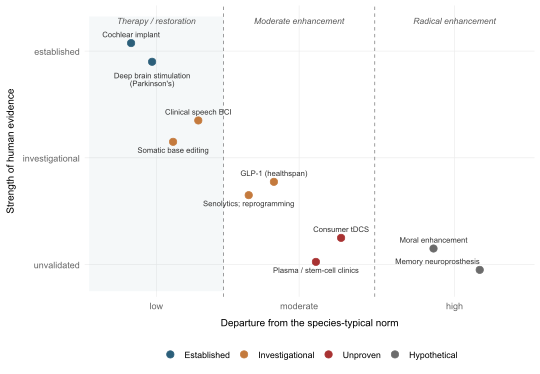
Two facts emerge from the table that the abstract debate tends to obscure. The first is that the NBIC interventions with the strongest evidence are overwhelmingly restorative. The cochlear implant, deep brain stimulation, the speech and motor brain–computer interfaces now restoring communication to people locked in by paralysis or motor-neurone disease (Littlejohn et al., 2025; Willett et al., 2023), and the first patient-specific in vivo base-editing therapy (Musunuru et al., 2025) are, every one of them, attempts to return a damaged human toward the species-typical norm rather than to push a healthy one beyond it. They sit, on the distinction drawn above, firmly on the therapy side of the line. The second fact is that the genuinely enhancing claims — the consumer brain-stimulation devices that promise sharper cognition to the already healthy, the regimens that promise a postponed senescence — are precisely the ones the evidence does not support. The umbrella review of randomised trials of transcranial direct-current stimulation found its effects weak, inconsistent and unestablished for enhancement in healthy users (Kang et al., 2024); the longevity-clinic regimens fare worse (Demaria, 2025). Figure 15.1 maps the same point onto two axes.

Code
library(ggplot2)

d <- data.frame(
  label = c("Cochlear implant", "Deep brain stimulation\n(Parkinson's)",
            "Clinical speech BCI", "Somatic base editing",
            "Senolytics; reprogramming", "GLP-1 (healthspan)",
            "Consumer tDCS", "Plasma / stem-cell clinics",
            "Memory neuroprosthesis", "Moral enhancement"),
  x = c(1.0, 1.5, 2.6, 2.0, 3.8, 4.4, 6.0, 5.4, 9.3, 8.2),
  y = c(9.3, 8.6, 6.4, 5.6, 3.6, 4.1, 2.0, 1.1, 0.8, 1.6),
  status = c("Established", "Established", "Investigational",
             "Investigational", "Investigational", "Investigational",
             "Unproven", "Unproven", "Hypothetical", "Hypothetical"),
  vj = c(-0.9, 1.7, -0.9, 1.7, 1.7, -0.9, -0.9, 1.7, -0.9, -0.9),
  hj = c(0.5, 0.5, 0.5, 0.5, 0.5, 0.5, 0.5, 0.5, 1.0, 0.5)
)
d$status <- factor(d$status,
  levels = c("Established", "Investigational", "Unproven", "Hypothetical"))

palette_book <- c(
  "Established"     = "#2c5f7a",
  "Investigational" = "#c47a3d",
  "Unproven"        = "#a83232",
  "Hypothetical"    = "#6b6b6b"
)

ggplot(d, aes(x = x, y = y, colour = status)) +
  annotate("rect", xmin = 0, xmax = 3.2, ymin = 0, ymax = 10.3,
           fill = "#2c5f7a", alpha = 0.045) +
  geom_vline(xintercept = 3.2, linetype = "dashed",
             colour = "grey55", linewidth = 0.4) +
  geom_vline(xintercept = 6.8, linetype = "dashed",
             colour = "grey55", linewidth = 0.4) +
  annotate("text", x = 1.6, y = 10.15, label = "Therapy / restoration",
           size = 3.0, colour = "grey35", fontface = "italic") +
  annotate("text", x = 5.0, y = 10.15, label = "Moderate enhancement",
           size = 3.0, colour = "grey35", fontface = "italic") +
  annotate("text", x = 8.7, y = 10.15, label = "Radical enhancement",
           size = 3.0, colour = "grey35", fontface = "italic") +
  geom_point(size = 3.1) +
  geom_text(aes(label = label), vjust = d$vj, hjust = d$hj,
            size = 2.7, colour = "grey20", lineheight = 0.85) +
  scale_colour_manual(values = palette_book, name = NULL) +
  scale_x_continuous(limits = c(0, 10.5),
                     breaks = c(1.6, 5.0, 8.7),
                     labels = c("low", "moderate", "high"),
                     expand = expansion(mult = c(0.01, 0.01))) +
  scale_y_continuous(limits = c(0, 10.5),
                     breaks = c(1, 5, 9),
                     labels = c("unvalidated", "investigational", "established"),
                     expand = expansion(mult = c(0.02, 0.02))) +
  labs(x = "Departure from the species-typical norm",
       y = "Strength of human evidence") +
  theme_minimal(base_size = 11) +
  theme(
    panel.grid.minor = element_blank(),
    panel.grid.major = element_line(colour = "grey92", linewidth = 0.3),
    legend.position  = "bottom",
    axis.title.x     = element_text(size = 10, margin = margin(t = 6)),
    axis.title.y     = element_text(size = 10, margin = margin(r = 6)),
    axis.text        = element_text(size = 9, colour = "grey40")
  )
Figure 15.1: The enhancement space, illustrative. Each point locates an intervention by its departure from the species-typical norm (horizontal axis: therapy and restoration on the left, moderate enhancement in the middle, radical enhancement on the right) and by the strength of the human evidence supporting it (vertical axis). The dashed lines mark the therapy/enhancement boundary and the moderate/radical boundary of Agar (2010). The well-evidenced interventions cluster in the lower-left restorative quadrant; the radical-enhancement claims that animate transhumanism sit, so far, in the unvalidated and the hypothetical. Coordinates are transcribed for illustration, not computed, and should be read as a conceptual map rather than a measurement.

The same discrimination applies, with particular force, to the cognitive decline of later life — the target that most tempts the conflation of therapy with enhancement, because the line between restoring a faltering memory and improving a sound one is so easily blurred in the marketing. Here the evidence is starkest. The interventions with demonstrated benefit for cognition are, again, restorative and clinical: deep brain stimulation for the complications of Parkinson’s disease; cochlear and retinal prostheses that, by returning a lost sense, relieve the cognitive load that sensory deprivation imposes on the ageing brain. The interventions marketed for cognitive enhancement in the healthy older adult — the consumer transcranial-stimulation headset, the gamified “brain-training” subscription, the nootropic stack — are precisely the ones a pooled analysis of the randomised evidence finds weak, heterogeneous and, for real-world gain in healthy users, unestablished (Kang et al., 2024). The asymmetry is no accident of the present moment. It reflects the underlying truth that medicine knows how to return a damaged function toward its norm far better than it knows how to push an intact one beyond it, and that the further a claim sits from restoration, the thinner, so far, the evidence beneath it.

The lesson is not that radical enhancement is impossible; the convergence is young, and the speech prostheses and somatic editors that now read as therapy were, a decade ago, the stuff of the same speculative literature that today imagines the memory chip. It is that the plausibility has shifted on the therapeutic axis, not the enhancing one. Gene editing and neuroprosthesis have made restorative interventions plausible — and, in named individuals, real — that were until recently too risky to attempt; they have not made enhancing interventions evidenced. To treat the demonstrated success of the former as a down payment on the promise of the latter is to repeat, in the laboratory, the category error the longevity clinics commit in the marketplace.

15.3.3 Where the argument settles: species relativism and the Principle of Humanity

The most useful framework for the closing question comes, unexpectedly, from a thinker who spent a career arguing against radical enhancement and has lately allowed that there are conditions under which it might be required. The argument turns on two ideas. The first is species relativism: the claim that judgements of value are made relative to the kind of being that makes them, so that what counts as a good life for a radically enhanced descendant need be neither better nor worse than what counts as a good life for an unenhanced human, only different, and incommensurably so (Agar, 2010). The second is the Principle of Humanity, advanced in the context of a speculative argument about human settlement beyond Earth but stated as a general constraint: when choosing among enhancements, we should defer to the considered judgements of those best placed to know what is valuable about being human as we now are — the unenhanced — and should, in case of doubt, prefer less enhancement to more, the reversible to the irreversible, the moderate to the radical (Agar, 2025).

Applied to ageing, this framework cuts cleanly, and in two directions. Against the transhumanist and the commercial overreach, the Principle of Humanity counsels exactly the conservatism the evidence already recommends: a presumption against the radical, the irreversible and the unvalidated, and a deference to the considered judgement that there is something in a finite, embodied, species-typical human life worth not trading away for a speculative upgrade. The marketplace of borrowed credibility, the memory prosthesis, the pursuit of an engineered post-humanity — these are where the principle bites. But the same framework largely exonerates the central project of the preceding parts. Postponing the decline of late life, on the therapy/enhancement boundary inherited from the previous chapter, is overwhelmingly an exercise in restoration: it returns the ageing organism toward a function it once had, rather than pushing it beyond the human maximum. It sits in the lower-left quadrant of Figure 15.1, among the therapies, not the radical enhancements. The Principle of Humanity does not condemn geroscience; it condemns the conflation of geroscience with a programme to remake the species, and it supplies the criterion by which the two can be told apart — the criterion the marketplace works hard to blur.

The somatic–germline distinction drawn in the previous chapter maps onto this conclusion with some precision. Somatic restoration — the senolytic, the partial reprogramming, the in vivo base edit confined, as in the first treated infant, to the cells of one body and one life (Musunuru et al., 2025) — is the modest, defensible centre of the field, the place where the Principle of Humanity offers no objection because no remaking of the human kind is in train. Heritable, germline, species-level modification is where the principle’s caution becomes a brake, because there the choice is made on behalf of beings who cannot be consulted and whose nature is being set rather than repaired. The line that ethics drew in Chapter 14 is the same line philosophy draws here, approached from the other side: the postponement of an individual’s decline is one thing, the redesign of the species is another, and the entire weight of the argument falls on keeping them distinct.

A residue remains, one the consolation traditions identified at the outset. Even granting that geroscience is therapy and not radical enhancement, even granting that a postponed decline is a restoration and not a transgression, the Makropulos question does not dissolve. Whether a substantially longer life is a substantially better one is not settled by showing that it is medically permissible to seek it; that question turns, as Williams and his critics agree even as they disagree about the answer, on what those added years would contain and on whether the self that lived them would still be one for whom things could matter (Fischer, 2024; Williams, 1973). The traditions that made finitude a fixed point were answering this question — how to live well as a being with a term — and the unsettling of the frame does not retire their question but sharpens it. A creature who can adjust the term must decide what the term is for, and no amount of biology will make that decision for it. The science of the preceding parts has handed the species a dial it did not have. It has not told it where to set it, and the disciplines that might — the ones surveyed in these pages and the ones that lie beyond them — have only begun the work.

The two modern accounts of death’s badness frame that open question precisely. The deprivation account holds that a death is worse the more good life it forecloses, which seems to license the indefinite postponement of decline; the Makropulos argument holds that the good a long life forecloses may itself run out, so that past some point a further postponement deprives one of nothing worth having. On inspection they do not contradict each other. The deprivation account explains why averting an early or a decline-ridden death is a benefit; the Makropulos argument explains why that benefit need not extend without limit, and why the operative question is not how long but how much of what matters a longer life would hold. A geroscience that compresses morbidity and restores good years to a life that disease would have cut short is, on both accounts, doing good. A project aimed instead at sheer duration, indefinitely prolonged, would have to answer the harder question the ancients posed and the moderns have not closed — and would find that biology, having surrendered the dial, falls silent exactly where the question turns philosophical.

The arc that began with a single ageing cell closes on a question about the whole of a human life. The molecular chapters showed that ageing has the form of a reversible loss of identity; the clinical chapters showed how far the reversal is, and is not, yet real; the social chapters showed who would gain and who would pay; the ethical chapter asked what we may do; and this one has asked what, in doing it, we would be presupposing about ourselves. The Principle of Humanity offers not a prohibition but a posture — prefer the reversible, distrust the radical, keep the restoration of a life distinct from the redesign of the kind — and that posture is the nearest thing to a conclusion the argument will yield. The Epilogue takes up what it would mean to live, and to govern, as though all of this were true.


  1. The systematic character of the practice is the point: Hadot’s account of ancient philosophy as a way of life shows the meditatio mortis to be one exercise within a disciplined programme aimed at transforming the practitioner’s relation to existence, not an occasional rhetorical consolation (Hadot, 1995). Seneca’s letters and Marcus Aurelius’s Meditations are the central primary sources for the exercise in its Roman form (Aurelius, 2002; Seneca, 2004).↩︎